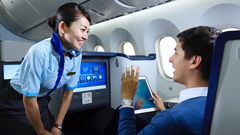
Qantas will put an Apple iPad 2 in every seat on planes in its domestic Boeing 767 fleet, using wireless streaming to beam movies, TV shows and music to the tablets.
The airline's 'Q Streaming' system, which was trialled on a single aircraft earlier this year, will be rolled out across the 767 fleet, with the devices offered free of charge to travellers in business and economy.
The 767s lack individual per-seat video for passengers: there’s just a few small screens in the bulkhead and hanging from overhead.
Qantas says the first Boeing 767 with the new system will roll out in the fourth quarter of this year and will predominantly operate on east coast 'triangle' routes between Brisbane, Sydney and Melbourne, as well as the five-hour trek to Perth.
However, it seems that the iPads won't make their way across the Red Roo's entire 21-stong Boeing 767 fleet.
When Australian Business Traveller sought clarification on how many aircraft would be fitted with the technology, a Qantas spokesperson told us that while the airline "plans to roll out Q Streaming across the B767 fleet, we’ll continue to review retirement options for some of the B767s and will have a definitive number in due course."
All passengers on an iPad-equipped 767 will find an iPad 2 sitting in their seat-back pocket, while those in business class will also get a flexible stand which can be used on the fold-down meal tray.
The planes will carry one tablet for every seat, with several spares on hand.
A special ‘Q Streaming’ app loaded onto the iPad act as the front-end for 'on demand' content broadcast from a central server on the aircraft.
Qantas says the iPads are "locked down", bypassing Apple's normal home screen and booting straight into the Q Streaming app.
Video: Q Streaming in action
Earlier this year Australian Business Traveller took to the skies to try Q Streaming in the trial, which used technology provided by Lufthansa Systems.
Although Qantas has opted to roll out Q Streaming using a different platform provided by Panasonic, the basics of streaming content via WiFi to the iPad will remain the same, although some aspects such as the look and feel of the Q Streaming app will change.
The video below, and the photos and report which follow, are based on the original Lufthansa Systems' implementation of Q Streaming.
How Q Streaming works
When switched on, the iPad launches straight into a welcome screen which hides all standard iPad apps and exposes only the Q Streaming app.
To connect to the 767’s Q Streaming network and content server, enter your seat number.
Each iPad connects to one of five wireless access points, fitted in ceiling compartments running down the right side of the cabin.
For the technically-inclined, each hotspot uses a dual-band 802.11n WiFi box which Qantas says can handle all 254 passengers watching the same program at the same time while enjoying smooth playback.
The access points work just like the wireless hotspot in a cafe or hotel, although as these are password-protected you can’t log onto them with your own tablet or laptop.
However, the Qantas-supplied iPads have all been preset with the network password and WiFi is activated on startup, for instant hassle-free connection to the network and the server. (And even if you could get onto the network you’d need special software to access the Q Streaming system.)
The Q Streaming app’s clean and elegant interface is very iPad.
Content is divided content into four categories – TV, music, prerecorded radio-style programming plus shows to keep the kids occupied.
Of course there’s rooms for additional types of content such as movies, ebooks, games and travel information, along with interactive features like in-seat ordering of food, drinks and (on international flights) duty-free shopping.
None of the in-flight videos or music is stored on the iPads – everything is sent from a ‘content server’ system located under the floor near the cockpit.
This mini-computer has a pair of identical 500GB solid state drives, each of which contains all the in-flight programming so that even if one drives fails the Q Streaming system will keep running.
The Feedback tile launches a survey to poll passenger opinion on the system, as well as what types of technology they usually travel with and other content they’d like added in future.
Some of the Q Streaming menus run several layers deep: for example, tapping TV reveals programming categories such as documentaries, comedy, drama and travel.
Tap any of these and you can see the specific shows on offer.
Another tap takes you to a list of available episodes for each TV series.
In most cases there’s also a synopsis screen describing the show.
It’s all very much what you’d expect on a conventional in-flight entertainment system, but done with simple taps and swipes and delivered right into your hands.
Transparent on-screen controls let you pause, forward and rewind video as well as manually ‘scrub’ forwards or backwards to specific points in the programme.
This control panel appears when you tap the screen and fades away a few seconds after being used.
The selection of MP3 music works much the same was TV shows: choose an album, click play, then sit back and listen.
Speaking of listening… if you find yourself on the Q Streaming 767, do your ears a favour and plug your standard iPod or iPhone earbuds into the headphone jack (either of the two sockets will do, because both carry stereo).
You’ll be rewarded with richer, crisper and punchier sound compared to the Qantas-supplied headphones, even though these are the same ‘noise-reducing’ headphones as seen on trans-Tasman and coast-to-coast flights.
(Also, don’t try to remove the double-prong headphone adaptor: it’s glued to the iPad to ensure the tablet’s own speaker is disabled.)
If you're sitting in economy, the tricky bit is trying to fit the iPad onto your tray table at the same as any meal or snack. Even thought the case doubles as a back-folding stand it's a very tight fit.
Passengers at the pointy end have things a bit easier, as they can fold back the case's cover and slide it into the seat-back pocket so that the iPad hangs down.
It's far from an ideal fix but once again, this is trial & testing territory and Qantas is already well aware of this situation – it will be interesting to see how the final Q Streaming system differs from these trials, and we'll being you a hands-on report on the new technology when it's rolled out towards the end of this year.
What's your take: is wireless streaming to tablets the way forward for inflight entertainment? Share your thoughts in the comments box below.
Follow Australian Business Traveller on Twitter for the latest updates for business travellers: we're @AusBT.
About David Flynn
David Flynn is the editor of Australian Business Traveller and a bit of a travel tragic with a weakness for good coffee, shopping and lychee martinis.


1 on 19/7/12 by born2flyjet