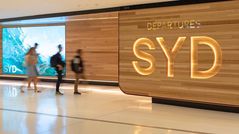
Sydney and Melbourne Airport are now using controversial full-body scanners, with international travellers being randomly selected for screening -- and unable to opt out unless they have a solid medical reason.
Passengers who are selected for a body scan but "refuse to undergo the body scan, and do not have a valid medical or physical condition, will be not permitted to board their flight" Melbourne Airport warns.
The scanners are being rolled out at all of Australia's major international airports this month and are also operational at Brisbane and Perth. Adelaide, Darwin, Cairns and the Gold Coast will come in the next three weeks.
Yet despite recommendations for "a comprehensive communications strategy" in the official report (download this as a PDF) from 2011 trials of the machines in Sydney and Melbourne, there seems to have been little if any public information campaign from the Government or the respective airports.
So here's what you need to know.
Fewer worries about safety and privacy than in the US
These 'active millimetre-wave' scanners rely on different technology than the backscatter X-ray variety which have raised as-yet-unproven health concerns in the States. Nor are they the same ones which privacy advocates have tagged as "nude-o-scopes".
Instead of your naked form, the machines show only a generic outline of the human body with a yellow box over any suspicious items on your person.
Security staff can then target only that part of your body to check for contraband.
No opt-out of random selection
But unlike the screening system at US airports, once selected for a random screening at Australian airports you won't be able to opt out of the process in favour of a physical pat-down unless you fall into a few medical categories.
From the Government's Travel Secure advisory page:
If a person refuses to undergo a body scan, and they have no medical or physical condition which prevents them for undertaking a body scan, they will be refused clearance and not allowed to pass through the screening point. They therefore will not be allowed to board their aircraft.
Simply put: no scan, no fly.
Adjust your frequent flyer wardrobe
Frequent flyers might need to adjust their inflight clothing choices, especially as Australian tests proved you're six times more likely to set off the alarm going through a body scanner than a metal detector.
It's no longer enough for you to be metal-free, since the scanners set off alarms for non-metallic items too.
Pockets, jeans studs, zips and buttons, folds in your clothing, baggy outfits and sequins were the five most common clothing-related items to set off the alarms in the 2011 tests.
Don't forget to take everything out of your pockets
Part of the reason for people setting off the alarms more frequently is that you now need to get rid of non-metallic items in your pockets, on your person or even in your hair.
Security people call these "divestible items": the things you should put in an X-ray machine tray with your laptop and coat.
The Australian trials found 230 divestible items on passengers per 1000 body scans, compared with 49 items per 1000 metal detector scans.
Hair clips made up 21 percent of the alarms, jewellery 20 percent and currency 17 percent. So those are definitely things to skip or put in the tray to go through the X-ray scanner.
Better screening personnel will be needed, too
The results from the 2011 trials in Sydney and Melbourne recommended: "In particular, it was noted that training for screening officers will require a much greater focus on customer service."
"Effective and clear communications to inform passengers about the process will also be essential," the report said.
"Tolerance" and "good manners" were included on the screening training suggestions list.
For more on the new body scanners, visit the Australian Government Department of Infrastructure and Transport.
Follow Australian Business Traveller on Twitter for everything you need to know about business travel: we're @AusBT.
About John Walton
Aviation journalist and travel columnist John took his first long-haul flight when he was eight weeks old and hasn't looked back since. Well, except when facing rearwards in business class.


1 on 6/12/12 by edy4eva