





Update | Scoot will launch on June 6 – click here for all the details. And if you're looking for photos and details of Scoot's economy and business class seats, we've got 'em!
Previous | Is there room for yet another airline in the Asian-Pacific skies? Scoot thinks so, and it hopes Australian business travellers will agree when the low-cost carrier debuts with a daily Sydney-Singapore service in June 2012.
Scoot is promising fares up to 40 percent lower than full-service carriers such as Qantas and its own parent Singapore Airlines.
Scoot CEO Campbell Wilson believes the rich vein of small-to-medium businesses in both Sydney and Singapore is ready to be tapped by an airline which focuses on finding the sweet spot for value – a point which sits somewhere between the lowest ticket price and premium service.
“It’s a little bit naive for anyone to believe that there is only one market segment willing to fly a no-frills airline” says Wilson, who aims to ensure “the price gradient from the normal cabin to a premium cabin is not so steep."
This means a lot of assumptions about business travel will be swept aside, quite likely including the ‘business class’ moniker itself.
Scoot “premium class”
Wilson and his team refer to the pointy end of Scoot’s Boeing 777-200 fleet as a premium cabin, while the FlyScoot website calls it Premium Class, to avoid the association with international business class of full-service airlines.
“We haven’t decided what we’re going to call it” Wilson admits to Australian Business Traveller. “We want to get away from the presumption that it’s a full-service business class, but we also want to ensure it’s sufficiently differentiated from the economy so that people will see the value in it.”
“But you have to face reality too. A lot of carriers have tried to brand their premium cabin as something other than ‘business class’ with very little success, so most have reverted to calling it business class anyway.”
Update: Scoot has settled on ScootBiz as the official name for the front cabin, and on its website openly describes the front cabin as "a Business Class experience".
The full ScootBiz offering includes
- preferred seat selection
- fast-track check-in at Scoot's dedicated ScootBiz counter
- priority boarding
- an iPad for in-flight entertainment
- in-seat power
- up to two free meals, with drinks, depending on the flight
- 15kg or two bags of carry-on baggage
- 20kg of checked luggage
- a comfort kit on overnight flights
Scoot’s premium seats
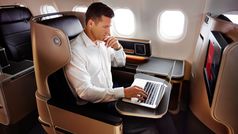
Names aside, Scoot’s premium seat certainly won’t be business class as most travellers know it.
Wilson revealed to Australian Business Traveller that Scoot will use a premium economy seat designed by German firm Zim at the pointy end of its planes.
Each of Scoot's Boeing 777s will be fitted with 32 premium seats. These will be 22 inches wide, with a pitch of "at least 38 inches" and an 8 inch recline.
Wilson doesn’t expect Scoot’s premium economy seat to be a hard sell to business travellers.
“Of course you’d take a lie-flat seat if you were given the choice but are you prepared to pay for that privilege?” he asks.
“A lie-flat seat consumes a huge amount of space and it’s a very expensive seat to build and maintain. Our target market wants value and they also really just want to get from A to B in many respects.”
Wilson says everybody at Scoot “was quite impressed with the comfort and recline in the Zim seat, and we believe our passengers will be as well. We got bids in from all the big seat manufacturers but Zim had the right price, the right product and the right delivery schedule.”
From tip to tail, none of the seats on a Scoot plane will be fitted with conventional in-seat video screens.
The airline will instead rent out Apple iPads, which will at first be pre-loaded with content although a move to wireless streaming (similar to Qantas' Q Streaming) is tipped by year's end.
No points, perks or KrisFlyer privileges
Eager to contain costs and avoid cannibalising Singapore Airlines' customer base, Scoot will ditch most off-board business travel benefits.
Business class passengers won’t have access to SQ’s Silver Kris lounges, Wilson told Australian Business Traveller.
Nor will SQ’s KrisFlyer members get any additional privileges when flying Scoot, such as an extra checked baggage allowance.
Scoot won’t be part of Star Alliance or even have a frequent flyer program “in the beginning, although whether that happens in years to come, time will tell” WIlson concedes. “But we want to walk before we run.”
Something else you won’t see on Scoot will be a codeshare arrangement with Singapore Airlines – although Wilson doesn’t rule out looser ‘interline’ arrangements under which passengers can book multiple segments of a trip on multiple airlines, with their baggage being transferred between airlines.
“There are no plans for codeshare but there may be interline arrangements with other members of the group, maybe even with Singapore Airlines itself, but that would have to be their decision.”
Wilson admits he’s already had interline discussions “with a bunch of airlines”, but wouldn't confirm that Virgin Australia was among them.
“We’ve expressed our interest (to them) but again, each airline has to make its own decision. If Virgin decided they want to work with us, a traditional interline relationship would be helpful for both parties. But it adds some complexity and costs. Provided we can manage those, we’re willing to work with anyone who is willing to work with us.”
On “Scootitude”
The X factor in all this, Wilson expects, will be how the airline interacts with its customers, to weave Scoot’s low price into a unique and even enjoyable experience at odds with the perceptions of no-frills airlines.
“We don’t believe that ‘no-frills’ means ‘cheap and nasty’” Wilson affirms.
“It’s not (Singapore’s) heritage, it’s not the airline group’s heritage and it’s self-defeating in a lot of respects. Any low-cost carrier will struggle for a point of difference because when you take out the frills, what is left to differentiate yourself with?”
“It really comes down on how you deliver to the consumer. It has to be on the airline’s personality, the way you interact with people, and that’s what we call Scootitude, or the unique Scoot attitude.”
As Wilson sees it, Scootitude will guide everything from how staff deal with passengers through to internal procedures, manuals and how the ‘fine print’ of a ticket’s terms and conditions are written.
“Scootitude will be incorporated right into our DNA.”
Throw a dart at any list of marketing buzzwords and you’ll hit something associated with Scootitude – fresh, young, dynamic, different. Maybe even cheeky or funky, yet definitely with that amorphous ‘vibe’.
But isn’t this already being done by a number of airlines?
“It is” Wilson concedes, “but I’m not sure it’s being done sufficiently well or sufficiently consistently.”
So just what is Scootitude, and how is it different?
Wilson admits that “to a large extent Scootitude (still) needs to be defined. We’re actually having a couple of days offsite with all of the team to define exactly what it means.”
Asked to name non-aviation companies which already display some form of ‘Scootitude’, Wilson is quick to cite Apple. “The brand itself says a lot without saying a lot, in some respects. It would be nice to be regarded in the same way, that the Scoot name or branding doesn’t need to be explained in the same way that Apple doesn’t need to be explained."
“I think the way Volkswagen introduced their Beetle remake a few years ago, that was taking a familiar concept and doing something different with it.”
The disparate members of Richard Branson’s Virgin empire also gets a nod. “The Virgin group has that unique intangible that people recognise is from the same family.”
About David Flynn
David Flynn is the editor of Australian Business Traveller and a bit of a travel tragic with a weakness for good coffee, shopping and lychee martinis.


1 on 5/12/11 by scibo10