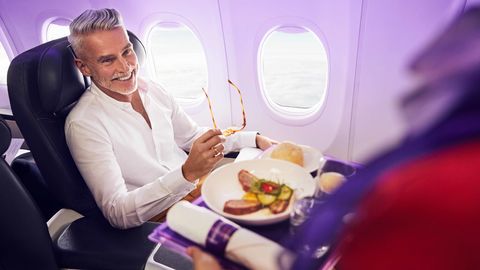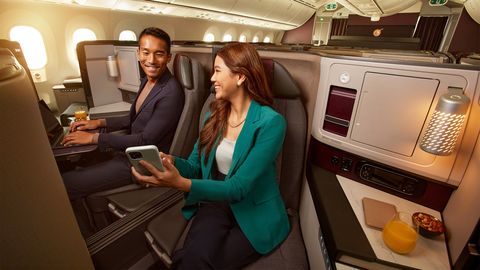

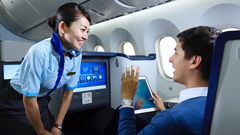



2012 is already an exciting year for business travellers, with new business class seats, new direct flights, new connecting hubs and new planes on the routes you fly.
But what's on the horizon? After interviewing key senior executives from airlines and the two main planemakers, Airbus and Boeing, Australian Business Traveller has identified five key trends that will affect your business travel -- for better or for worse -- over the coming few years.
1. More (and better) business class, less first class
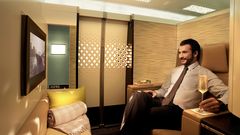
We're calling it: expect more and more airlines to cut their first class cabins, mostly in favour of the better fully-flat business class seats with direct aisle access.
Both major planemakers are seeing less first class ordered -- and that covers both Airbus' A350 XWB and Boeing's 787 Dreamliner.
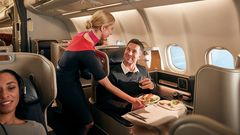
The new breed of business class seats are already eclipsing the first class offerings of just a decade ago, with fully flat beds, direct aisle access -- and, of course, all the technological innovations ten years bring.
Alas for the frequent flyer, that's likely to mean fewer opportunities to redeem your points and miles for ultra-swanky seats. Expect a gradual reduction of top-notch first class lounges, too, although many airlines will keep extra-special lounges for their most frequent flyers.
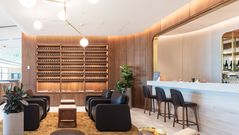
On the plus side, we reckon this means that business classes -- and business class lounges -- will get better overall, especially for those really long-haul flights to the Americas and Europe.
2. Fully flat business class beds eclipse lie-flat seats
With business class taking centre stage, it makes sense that business class seats will be getting more comfortable.
We reckon that, for the longest flights, you'll start seeing the more comfortable completely horizontal business class beds replacing those sloped, angled "lie-flat" seats that have been a long-haul standard for most of the last decade.
For "mid-haul" regional flights (to South-East Asia, for example), we like the trend of better, more adjustable angled lie-flat seats we're seeing in new regional business classes already seen on Singapore Airlines and soon to be seen on Cathay Pacific in particular.
Why is "fully flat" better than "lie-flat"? Don't miss our image-laden guide illustrating the difference between lie-flat and fully-flat seats.
We predict that the older recliner style seats will be mostly removed completely from anything longer than the relatively short jaunts around Australia and across the Tasman -- and, in fact, you're less likely to see recliners even on those flights as Qantas and Virgin Australia continue to put their larger planes on the transcontinental runs.
3. More long-haul low-cost airlines like AirAsia X and Scoot
Depending on your travel policy, the rise of airlines like AirAsia X and Scoot, and the increasing range of Jetstar flights are either a blessing or curse.
We'll start with the curse: if the rules say you have to pick the cheapest economy fare, then you get stuck in an extra-narrow, knee-crunching seat for even the longest flights. No lounges, frequent flyer points or included meals detract from your airport and inflight productivity -- and, of course, they take away a bit of that magic of travel that motivates so many business travellers.
But the blessing is that their premium economy-style options can actually be pretty good. AirAsia X's Premium class includes lie-flat seats similar to many airlines' business classes, while Jetstar and Scoot's "business class" offerings are equivalent to premium economy on other airlines.
And, at the end of the day, competition for business travellers' dollar keeps other airlines on their toes. Let's just hope it doesn't make other airlines cut down on the amount of space we have for our knees.
4. Extra-narrow seats continue the march into economy
British Airways has a lot to answer for: it was the first airline to start squeezing narrow 17-inch seats into its Boeing 777 planes to get one extra seat in every row on its leisure flights.
Carving an inch and a bit from each of the nine seats in economy, and reducing the width of the aisles, BA managed to squeeze ten seats across the plane in a 3-4-3 layout instead of the previous nine in a 3-3-3 configuration.
British Airways quickly reversed its decision after sternly British letters of complaint -- but, as with many bad ideas, it spread to other airlines.
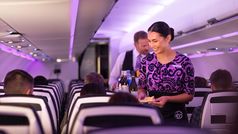
Air France, Air New Zealand, Emirates and KLM are among the full-service airlines to use the ten-abreast seating in their 777s.
Those 17-inch seats might be fine for an hour's up-and-down trip from Sydney to Melbourne, but with passengers getting taller and wider, it's a problem for longer flights.
Unfortunately, Boeing and Airbus are both offering a 17-inch seating option on their next-generation planes, the Boeing 787 Dreamliner and the Airbus A350 XWB.
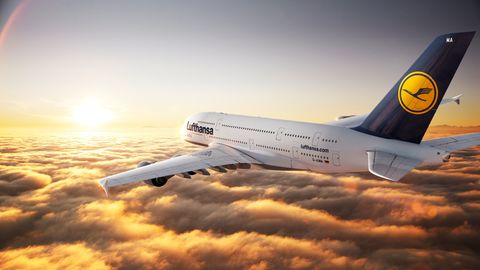
Airbus' cabin guru Zuzana Hrnkova confirmed to Australian Business Traveller in Toulouse in May that the world's biggest airliner, the Airbus A380, could see an extra seat squeezed in. That would turn the superjumbo into a cramped 3-5-3 mammoth rather than the relatively spacious 3-4-3 seating seen today.
And with the majority of passengers not willing to pay for a wider seat, we regretfully predict narrower economy seats to come.
5. Better inflight Internet on domestic and international flights
Australians travelling within the US will already be familiar with the fastest inflight wifi Internet available, which is beamed air-to-ground rather than via satellite.
Since it's widespread, it's also relatively well-priced, with market-leader Gogo currently offering 24-hour passes at US$13 and a month's unlimited use for US$40.
Since Gogo works on Air Canada, AirTran, Alaska Airlines, American Airlines, Delta, Frontier, United, US Airways and Virgin America, that $40 is a pretty good deal that covers over 1500 planes and a sizeable percentage of US domestic flights.
Outside the US, however, we're left without ground-to-air options. That means we get air-to-satellite Internet, which is slower -- and often eye-wateringly expensive.
While other airlines are progressively rolling satellite-based Internet out onto their newest aircraft, it's far from widespread. Check out the latest from:
Alas, it's unlikely that an air-to-ground Internet offering is going to appear in Australia any time soon. The lower population density means that it's simply unlikely to be economic.
Fortunately, things are looking up for air-to-satellite. With more airlines rolling out satellite-based technology, the R&D costs go down. And as passengers complain about spending as much to check their email via satellite as for a full day of use via the ground, prices are likely to drop too.
New technologies are also on the horizon, with Ka (pronounce the two letters separately: "K-A" rather than "car") and Ku ("K-U" rather than "queue") bands promising faster connections and more bandwidth.
Summing it all up: the future is bright
Despite the likely squeeze in economy, business class travel is likely to continue to improve as airlines try to outdo each other for your premium dollar. Fully flat seats will continue
But questions remain about how business travellers -- and companies -- will respond to the changing landscape:
- Will better business class start seeming too swish, relegating business travellers to premium economy?
- Will the shrinking availability of first class mean the loss of first class lounge benefits for top-tier frequent flyer programs?
- Will the low-cost airline revolution lead full-service airlines to cut comfort and service from economy class cabins?
- Will business travel itself slow down with increasingly appealing videoconferencing technology?
Share your thoughts with us -- and with your fellow business travellers -- in a comment below.
And for the very latest news, reviews and top tips for your business travel, follow us on Twitter: we're @AusBT.
About John Walton
Aviation journalist and travel columnist John took his first long-haul flight when he was eight weeks old and hasn't looked back since. Well, except when facing rearwards in business class.


1 on 18/6/12 by kash