


Prior to the opening of Virgin Australia’s new lounge at Melbourne Airport, Australian Business Traveller sat down with Tim Greer of Tonkin Zulaikha Greer Architects to discuss how he set about designing the lounge.
One lounge, many moods
An airport is a place of movement, Greer explains, but what makes an airport lounge unique from other buildings he’s designed – galleries, cinemas, offices and apartments – is that “the lounge is about a whole lot of people in one space who all want to do different things but at the same time.”
“They’re thinking differently, they are in different headspaces. Someone setting off on a trip has a different mindset to someone who has finished the day’s business.”
“At the beginning of the day a lounge is one thing, it’s people heading out. At the end of the day it’s something else, people want to relax and maybe kick up their heels a little bit.”
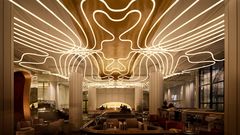
Despite those different modalities of a lounge, Greer chose to deliberately move away from turning Melbourne’s lounge into “a series of rooms”, and instead make fullest use of the area’s 1365 square metres.
“Given that the starting point was a nice big space, we though that the best strategy would be to have you flow from one space to another.”
The five ‘spaces’ of The Lounge
The use of different locations, furniture and materials helps create five unique zones within The Lounge, which Greer says will in one way or another be replicated across all Virgin Australia lounges as space permits.
- A quick stay space at the front of the lounge is for “people who just have 20 minutes – they want to grab something to eat and then they’re off again.”
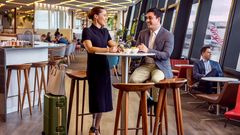
- The hub space is perhaps the most extensive of the lounge, designed with benches for for working and clusters of chairs and tables for networking or chatting with colleagues.
- The bar space is more of a social area, where travellers can cluster around long snaking high bars. “At the end of the day you might not want to sit down, you might want to stand up and have a beer” Greer says. “People can come and lean up against the bar. It’s a space that’s meant to be a bit of fun, where you can kick back and relax.”
- A library space combines different types of chairs in a quieter area buffered by carpet and curtains, and intended as a mobile-free zone where lounge guests can escape ring tones and chatter.
- Like the library, the verandah space – which in Melbourne projects out towards the airport’s tarmac and operational area – is removed from the bustle of the main lounge area. It’s not a quiet zone but it’s still for carving out your own space and putting everything else quite literally behind you.
Martin Daley, Virgin Australia’s Group Executive for Product & Guest Services, expects each area to have its own place during the pulse of the day.
“In the morning we think the central area, where the workstations and the high bar are, and the area adjacent to the servery, are going to be pretty busy."
"Perhaps later on in the day, the high bar – which has several different spaces of its own – will be more of a social area, a bit of work and play at the same time. At the end of a long day you can unwind there or you can sit in the library for some quiet, or go to the verandah and put everything behind you.”
Daley says that the airline conducted extensive research during the evolution of the design. “This is very customer-led, and what we learned from the feedback is that people want different things. So we’re trying to give people a choice in The Lounge, and that goes back to the airline as well – choice is our entire philosophy."
About David Flynn
David Flynn is the editor of Australian Business Traveller and a bit of a travel tragic with a weakness for good coffee, shopping and lychee martinis.


1 on 24/5/11 by danwarne