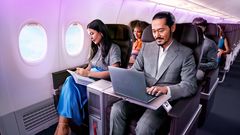
With both Qantas and Virgin Australia making noises about inflight Internet on domestic flights – albeit measured and non-committal noises – there’s an obvious curiosity factor among Australian business travellers.
What would it be like to step on a flight from, say, Melbourne to Brisbane and be able to jump online at 30,000 feet to fetch your latest email while the coffee comes around?
How useful would it be on the trans-continental trek from Sydney to Perth to not just finish a report or presentation on your laptop but send it off mid-flight?
We may see Aussie trials kick off towards the end of this year but for most airlines in America – including United, Alaska, American, Delta, Virgin America and US Airways – the Internet is just another inflight option sold alongside sandwiches and additional pieces of checked luggage.
So on a recent US flight with Virgin America we dropped a few coins in the slot and tested the airline’s in-flight internet to see just how useful a feature this really is.
We've already tested Qantas' new A380 Internet service, currenltly under trial on flights from Sydney and Melbourne to Los Angeles – read our exclusive review.
Like most US airlines, Virgin America relies on the Gogo service which taps into the nationwide mobile phone network.
The cost varies depending on the length of the flight and also the device used – for tablets and notebooks it’s US$5 for flights under 90 minutes, US$10 for 1.5 hours to 3 hours and US$15 if you’ll be travelling for more than 3 hours.
(Frequent flyers can stump up US$35 per month for unlimited Internet on all Virgin America flights, or US$40 to be covered for all Gogo-equipped planes on any airline.)
For smartphones and other ‘handheld devices’ the cost is the same US$5 for flights less than 1.5 hours, but US$8 for all flights of 1.5 hours and more.
To use an iPad during our flight from San Francisco to Seattle – a flying time of two hours – cost US$10, with the service available shortly after we took off from that scenic city by the bay.
As an aside, if you’ve never flown on Virgin America, it’s easy to see the shared parentage and subsequent design influences with Virgin Australia – including the purple plexiglass divider between economy and business class.
However, Virgin Australia doesn’t go quite as all-out in the funky stakes. For example, its business class is more sedate than the white leather seats of Virgin America’s ‘first class’.
Anyway, with cruising altitude reached, the Gogo Internet service was switched on.
Signing up was an absolute doddle...
... and inside of a minute we were on the air in the air.
The service proved sufficiently fast for light-duty activities such as web browsing and email, as long as no large attachments were involved.
Lightweight apps are also tailor-made for the narrowband pipe of sky-high Internet, but as soon as you start shifting a sizeable amount of data things slow down.
For example, the connection proved far too slow to update The Sydney Morning Herald iPad app with the day’s news.
This involves a data set of around 20MB, which places very little load on the wifi network of a hotel or airport lounge but stretches inflight Internet to its limits and becomes an exercise in Zen patience.
(And we should note that the SMH iPad app is also designed for offline use, where there's no Internet connection, in addition to being a more tablet0friendly way to visit the site live.)
We found it was much faster simply to visit the SMH website directly through the iPad’s Safari web browser.
If something similar to the Virgin America experience was available in Australia, would you use inflight Internet?
Speed is clearly one issue: nobody should expect anything near the speeds they enjoy at home of even the local cafe, and to some extent this naturally limits both usability and appeal.
Cost is another factor. Paying US $5 for a 90 minute flight – the same distance as Sydney-Melbourne or Sydney-Brisbane – is almost a no-brainer. For flights up to three hours, US$10 becomes a substantially higher ask but one that’s easily justified if you’ve got work to be done.
Last year we polled Australian Business Traveller readers on how much they were prepared to pay for inflight internet.
Some 38% said they expected the service should be free on flights lasting less than three hours, although the same number allowed that $5 would be a fair ask. Almost 20% volunteered they would pay as much as $10.
On flights from four to six hours, which covers coast-to-coast transcontinental services, two-thirds of AusBT readers would be prepared to pay up to $10 to stay connected.
Do you feel those figures are realistic, and would you use inflight internet if Qantas or Virgin Australia put it on the menu?
About David Flynn
David Flynn is the editor of Australian Business Traveller and a bit of a travel tragic with a weakness for good coffee, shopping and lychee martinis.


1 on 12/3/12 by airtraveladdict