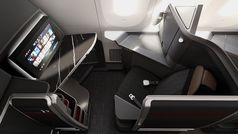
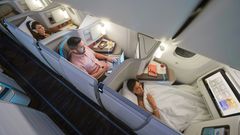
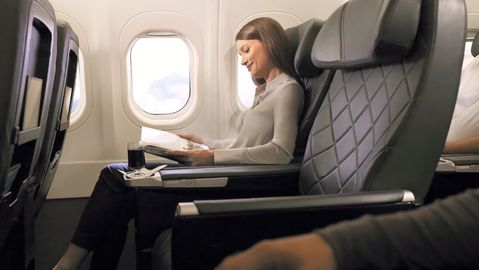
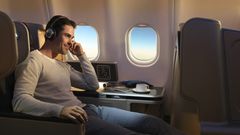
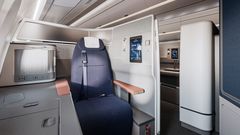
How do you make one of those sloped, angled lie-flat seats more comfortable on a long overnight flight?
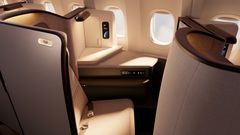
It's not always easy to find a decent position that lets you get enough sleep, even if it's officially a "flat" sat.
We at Australian Business Traveller call that the business class "lie-flat lie" -- and we try to give you as much information as we can to help you avoid them and find flights with fully flat beds instead.
But sometimes, on some routes, that's just not possible -- so we've put together some of our top tips on making yourself more comfortable during the flight.
Before you get on the plane
Let's start with what you can do when booking seats and at check-in.
Try to pick an empty row
Angled lie-flats are closer together than fully flat seats, so the elegant gazelle-like (or hippo-like) stride from window or middle seat to aisle is tricker.
They also often lack for storage space, which can be a pain.
At check-in, see how full the flight is and see if you can snag a row to yourself, with nobody sitting next to you. "Could you block this seat next to me? I need to get a lot of work done and I'd hate to disturb anyone with my laptop light" is a good gambit.
A spare seat gives you extra space to stash your things during the flight, an extra table surface for mealtimes (for your laptop or tablet, say) -- and, usefully, a second entertainment monitor to pull up the moving map so you can keep track of your journey.
If you want an aisle seat, pick the middle section
On many long-haul flights, you'll find a 2-2-2 or 2-3-2 seat layout in business class. If you're an aisle fan, pick one in the middle section of seats.
On a 2-2-2 plane, that means there's absolutely nobody climbing over you, since your neighbour uses the other aisle.
Meanwhile, if you're on a 2-3-2 jet, you'll find that the middle seats of three are the last to fill up -- nobody wants a middle seat! That means you're more likely to have a free seat next to you, and even if it's full, the middle seat passenger has only a fifty percent chance of disturbing you rather than the person on the other side.
Pack pyjamas or natural fibre trousers
The frustrating thing about angled lie-flat seats for most travellers is what travel wags term the "wedgie problem": you end up sliding down the angled surface while your underwear tries to remain where it is.
It's most exaggerated when you're wearing lined suit trousers, which are designed to be slippery -- bad idea in an angled lie-flat.
Pack a pair of PJ bottoms, a pair of linen shorts or even a pair of light natural fibre trousers, and change into them once the seatbelt "ping" goes after takeoff.
The flight attendants may well be able to hang your trousers with your jacket so that you can look less creased when you land.
Once you're on board
During boarding, spring into action and ask the cabin crew for a couple of extra things that you can use during the flight to make yourself more comfortable.
An extra blanket or duvet
See if you can grab an extra blanket or duvet to make the seat's surface a little softer.
There's part of the seat that will poke into just about every passenger, and a bit of extra cushioning can go a long way to avoiding being woken up in the middle of the night by a bit of metal or plastic.
Two extra pillows
If you have more pillows to play with, you can soften out the unergonomic parts of the seat and make it a bit more comfortable.
When sleeping on your back, have a pillow down where your feet are resting to take away some of the unnatural pressure from sleeping at an angle.
If you're a side-sleeper, these seats aren't designed for your comfort. Try popping a pillow between your knees to support your higher leg, and another underneath your ankles to soften the pressure on them.
Front-sleepers are likely to want pillows underneath their shins, especially on airlines where the shin/calf section of the bed drops away at an angle. Since knees don't bend that way, it's useful to raise and soften the level of the surface. (Consider also folding away that raise-up footrest, front-sleepers.)
How do you hack angled lie-flat sleeper seats when you travel? Got a favourite tip -- or an angled lie-flat that you avoid like the plague? Share your thoughts with your fellow AusBT readers in a comment below!
For the very latest from Australian Business Traveller, for live updates on breaking news, and for on-the-ground tips and tricks from our travels, follow us on Twitter! We're @AusBT.
Ready for more in-depth info on business class seats?
- Check out the AusBT photo guide to the different types of business class seating and cabin layouts
- See for yourself whether bulkhead seats really do give you extra legroom
- Don't miss how your personal legroom and what the airlines call "seat pitch" differ
- Pick up some tips on what to wear in the air: both the classic version and the "business casual" edition
- Boost your TQ (travel intelligence) with our five favourite advanced travel hacks
About John Walton
Aviation journalist and travel columnist John took his first long-haul flight when he was eight weeks old and hasn't looked back since. Well, except when facing rearwards in business class.


1 on 3/9/12 by adamH