






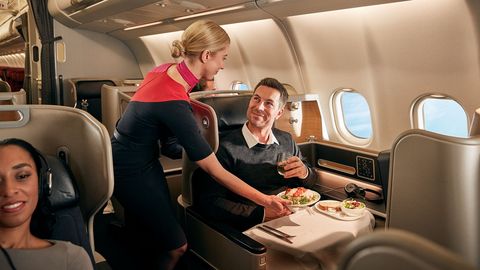
If IQ measures intelligence and EQ rates your emotional intelligence, consider TQ as your Travel Intelligence: an indication of 'travel savvy', your ability to travel smarter, faster, smoother and easier than the rest of the pack.
High-TQ travellers can draw on an arsenal of tips and tricks, some of which are useful even when you're on the ground.
Here's a quick list of five travel hacks that'll immediately boost your TQ!
1. Tame those timezones
Keeping time is important to every business traveller, and it gets tricky when abroad. Is that 10 o'clock your time or 10 my time? Oh, you meant 10 in the evening?
And are we talking Australian EST or United States EST? Let's not even discuss those places daft enough to offset their time from the rest of the world by thirty minutes. (SA and the NT, we're looking at you.)
Get travel-savvy by quoting time to colleagues and contacts in their own time zone, and being aware of timezone peculiarities.
Googling "time now in ______" is a good way to figure out simple conversions. When managing schedules and setting up phone interviews across several timezones the AusBT team often uses timeanddate.com.
2. Know how to quote and store your phone number
Anyone who's ever tried to dial international numbers from the US will have come across the odd American requirement to dial 011 before the country code.
That's tricky enough to get your head round, but a way to make life easier is to always quote and store phone numbers in the international style, with a + at the beginning.
So instead of noting down your office phone as (say) 02 5550 1234, write it down and store it as +61 2 5550 1234.
A high-TQ traveller knows that's useful when using your mobile from overseas -- without the + sign your phone will read numbers as a local call -- for the benefit of overseas contacts who might not know to drop the 0 in the area code, and for using services like Skype.
And whatever you do, don't quote it as 0061 02 5550 1234. That's wrong on so many levels.
3. Master the standard phonetic alphabet
The standard phonetic alphabet assigns a word to each letter: A is Alpha, B is Bravo, C is Charlie, and so on.
It's used by the military and in the air, but is remarkably handy in other situations where clarity is key... especially on the phone to a call centre over a crackly line or in a noisy conference room. Lots of letters have similar sounds and can be confused.
Being able to spell out your name, six-digit airline PNR reservation number and so on to an airline agent, hotel staffer or business receptionist is very useful.
After all, "M as in Melbourne" might not make sense if you're in Mumbai, Memphis or Mogadishu.
4. Speak enough of the local language to do names
In our experience, Australian business travellers who can speak the language of the country where they're doing business are still astoundingly rare.
A high-TQ traveller understands that, and can (at the very least) pronounce colleagues' and contacts' names. For example, the Chinese name "Wang" rhymes with "bong" not "bang".
There's any number of sources you can ask for help with language and pronunciation, from the Internet (Google Translate and its iPhone/Android apps are our favourites) to local colleagues to hotel concierges.
You can also have a listen to language learning podcasts on your next flight or search your smartphone's store for an app to brush up on your skills.
5. Keep frequent flyer and loyalty program numbers on your smartphone
There really is very little reason these days to bulk out your wallet with dozens of cards for your various loyalty programs -- airline frequent flyer memberships, hotel loyalty cards, car rental program numbers, and so on.
The airline or hotel doesn't really need to see your card, just your number. (If you're worried about missing out on miles or privileges on partner airlines when travelling abroad, say, you can always keep the cards in a separate wallet tucked away in your carry-on bag.)
The savvy traveller notes down the numbers and keeps them to hand when needed. The easiest way to do this is in a text file on your smartphone, which will sync to your computer for backup purposes.
If you want to get smart about it, you can use a synced document service like Evernote, an online spreadsheet, or one of the dedicated apps for tracking your frequent flyer points, passwords and numbers.
AwardWallet is our pick of the dedicated frequent flyer account apps for Apple's iOS and Android.
What's your favourite travel hack?
Share your own top travel knowledge with your fellow AusBT readers in the comments section below, or on Twitter -- we're @AusBT.
About John Walton
Aviation journalist and travel columnist John took his first long-haul flight when he was eight weeks old and hasn't looked back since. Well, except when facing rearwards in business class.


1 on 15/2/12 by sagidec