Cathay Pacific’s regional sibling Dragonair today unveilled new business class and economy seats as the airline aims to bolster its position in the Asian market, especially the rich vein of China’s growing middle class and manufacturing base.
Both seats adopt designs already used by Cathay Pacific. Dragonair expects to start flying the new seats in March 2013, with both seats fitted to the bulk of its Airbus fleet by the end of 2014.
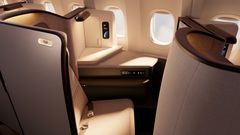
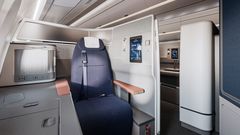
Dragonair's business class is Cathay's new regional business class (which CX will start flying later this month)...
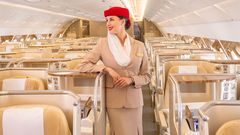
... while down the back of the bus you'll find the same economy seats as Cathay is now rolling out on its long-haul international flights, which debuted at the same time as it introduced premium economy.
There's also a new on-demand inflight entertainment system named StudioKA, modelled on Cathay Pacific's StudioCX system, with iDevice connectivity, USB ports and AC power sockets in every seat from tip to tail.
Dragonair spans 44 destinations in the greater Asian market from its hub in Hong Kong, and many Qantas travellers to Beijing, Shanghai and Taipei rely on Dragonair flights out of Hong Kong – with the added appeal of earning frequent flyer points and status credits on the trip.
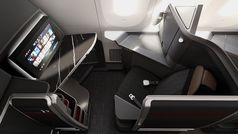
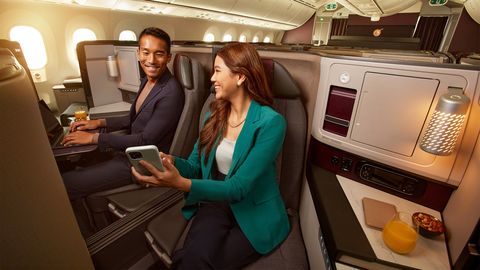
Dragonair's new business class seat
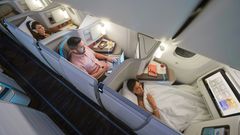
The hybrid design of the new business class seat borrows some elements from an angled lie-flat or ‘sloping sleeper’ seat and weaves them into the more conventional form of a recliner housed in a fixed shell, to protect your space from the recline of the passenger in front.
Seat pitch has been increased from 45 inches to 47 inches on the airline’s widebody aircraft and from 42 inches to 45 inches on narrowbody aircraft, while width has also been increased from 20 inches to 21 inches on all aircraft types.
That width makes it fairly generous compared to other regional business classes, and cleverly sculpted centre and side arms will provide extra space on either side for a bit more elbow-room.
The seat features independent electronic controls for recline and the legrest, and articulates into a “lazy-Z” position where your feet are supported by the extra-large reclining legrest, which rises up to support your legs.
There's also headrest with six-way movement and an amply-sized table which extends from the seat in front of you. At 20 inches wide and 14.5 inches deep it'll comfortably accommodate most laptops.
Every seat also gets a universal AC socket so that you can keep working and keep your gear juiced up en route and a 12.1 inch video touchscreen.
Here's how the old and new Dragonair business class seats stack up.
Dragonair's new economy class seat
The new economy class seat is the same as you'll find on most of Cathay's long-distance international flights, including all those between Australia and Hong Kong.
It's built around a cradle mechanism rather than a fixed shell and sports a 9 inch touchscreen with a handy storage nook below the screen where you can stow your MP3 player, reading glasses and other small items.
Again, here's the 'old vs new' chart...
StudioKA, USB and iDevices
As we mentioned earlier, the new StudioKA audio and video system is modelled on Cathay's StudioCX with the same familiar user interface and broad variety of content.
Every business and economy seat has its own AC powerpoint plus a USB port so you can charge your laptop, tablet or smartphone during the flight.
Dragonair also spruiks the system's ability to play music and videos from iDevices, but there's a catch: instead of using Apple's conventional 30-pin connector (or the newer Lightning connector of the iPhone 5 and iPad Mini), this is Panasonic's eXport multi-pin socket.
Here's a closer look at it on one of Cathay's premium economy seats.
To get video from your iDevice onto the in-seat screen you’ll need to use a special adaptor cable.
This has Apple’s unit iPod/iPhone connector on one end and plugs into the round multi-pin socket directly below the USB port.
You can then control video playback straight from your iDevice.
Cathay Pacific flight usually have a bunch of these on hand which are lent to passengers free of charge, and we'd expect Dragonair will do likewise.
But we suggest that frequent flyers buy their own in-flight adaptor cable (such as Griffin's eXport) to avoid being caught short.
Follow Australian Business Traveller on Twitter: we're AusBT.
About David Flynn
David Flynn is the editor of Australian Business Traveller and a bit of a travel tragic with a weakness for good coffee, shopping and lychee martinis.


1 on 24/1/13 by kash